How to analyze the new donor journey through analytics
By RaiseTell Insights ·

The first 13 months a donor spends on your file are the strongest predictor of their lifetime value. Most development teams measure only at acquisition — here's how to track what happens next, with benchmarks and a step-by-step framework.
Step 1 — Build your acquisition cohort
Define an "acquisition fiscal year" cohort — everyone who made their first qualifying gift in that year. Track total cohort size, total first-gift dollars, average first gift, and median first gift. Use both averages and medians: the median shows the typical new donor, while the average reveals where large gifts skew the picture.
Step 2 — Measure the conversion cliff
First-to-second-gift conversion is the single most important new-donor metric. Compute conversion rate, average months to second gift, and the share of converters who upgraded their gift amount. Donors who give more on gift two are dramatically more likely to retain a third time.
Step 3 — Add a speed curve
Plot conversion-by-month across this year's, last year's, and the prior year's cohort. A speed curve tells you whether your stewardship is getting faster or slower at moving donors from first to second gift — one of the clearest proxies for program health. Pair it with a 13-month retention rate: donors who haven't given by month 13 statistically lapse.
Step 4 — Segment by entry tier
A $25 first-gift donor and a $2,500 first-gift donor need different cultivation. Compute conversion, upgrade rate, and 13-month retention separately by entry tier.
| Entry tier | Typical first gift | Cultivation priority | Lapse risk |
|---|---|---|---|
| Bottom | $1–$99 | High volume, automated | Medium |
| Middle | $100–$999 | Personalized touches | High |
| Top | $1,000+ | Relationship-based | Critical to flag |
Step 5 — Flag lapsing mid- and top-tier donors early
Middle and top first-timers carry disproportionate future value. Flagging them within three to six months of going silent gives you time to intervene before they fade away. Set up automated alerts in your CRM based on last-gift date and tier.
Development team checklist
- Define acquisition fiscal year cohort and pull baseline metrics
- Calculate first-to-second-gift conversion rate and average time to gift 2
- Build a 3-year speed curve to benchmark stewardship velocity
- Segment all metrics by entry tier (bottom / middle / top)
- Set CRM alerts for mid- and top-tier donors silent after 90–180 days
- Report 13-month retention rate alongside acquisition numbers every cycle
- Track upgrade rate on gift 2 as a leading indicator of long-term LTV
Frequently asked questions
What is a good first-to-second gift conversion rate for nonprofits?
Most organizations convert fewer than half of new donors to a second gift. Rates above 45–50% are generally considered strong; above 60% is excellent. Your speed curve matters as much as the rate — faster conversion predicts higher lifetime value.
Why is 13 months the standard lapse window?
Most giving is annual. A donor who hasn't responded within 13 months has missed their likely renewal window plus a reasonable grace period. Data consistently shows retention probability drops sharply after this point.
What CRM or tools support this kind of cohort analysis?
Most major nonprofit CRMs (Raiser's Edge NXT, Salesforce NPSP, Bloomerang, Little Green Light) can produce cohort reports with configuration. Bloomerang and Fundraise Up include retention dashboards natively. For custom speed curves, export to Excel or Google Sheets.
How is donor lifetime value (LTV) connected to first-gift tier?
Entry tier is one of the strongest predictors of LTV, but upgrade behavior on gift two often matters more. A $50 donor who gives $75 on gift two is statistically more valuable over five years than a $200 donor who stays flat.
Related articles
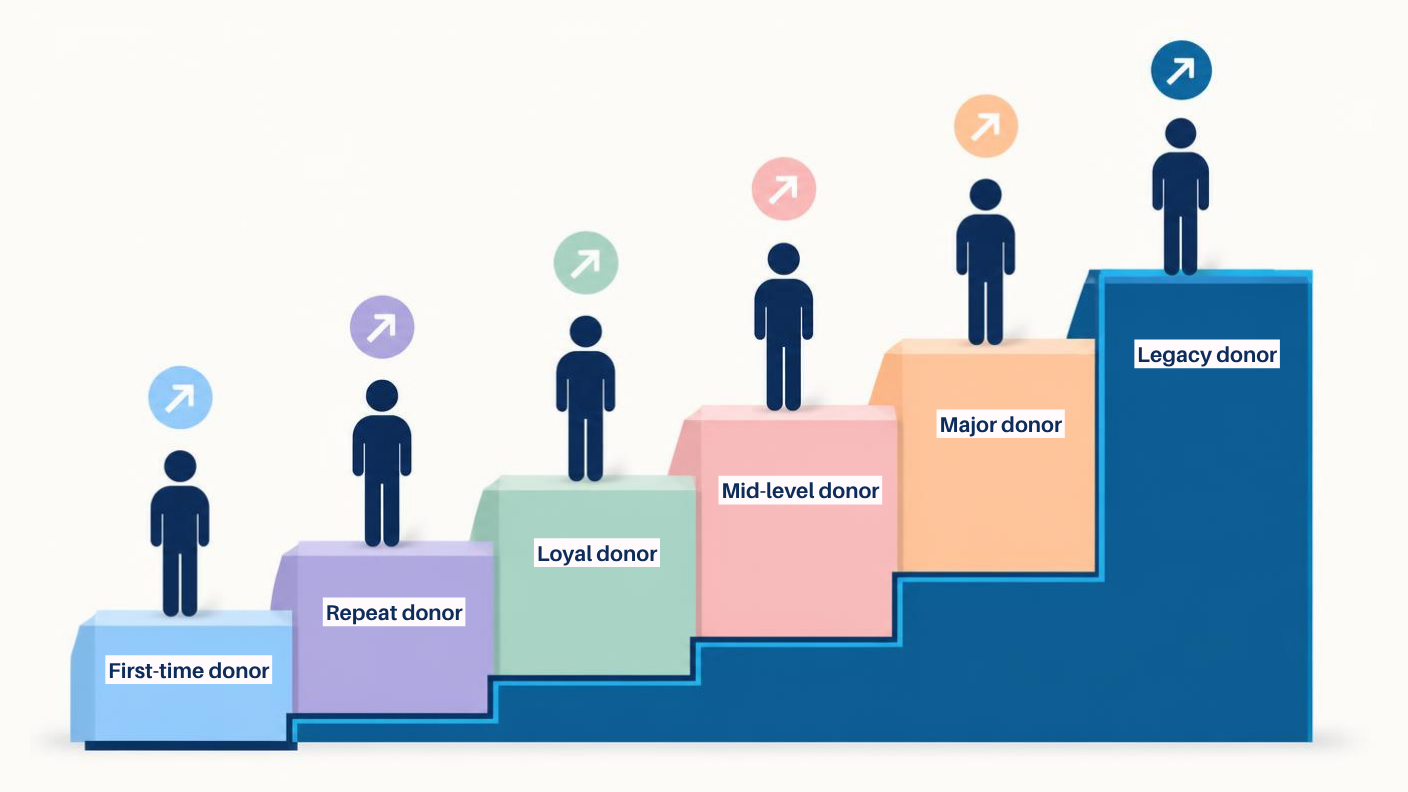
Fundraising · 7 min read
The Donor Lifecycle Explained: Know Each Donor's Next Move
Constituent Intelligence · 10 min read
When You're Ready to Go Deeper: Advanced Donor Analytics for Competitive Advantage

Article · 5 min read