The Donor Lifecycle Explained: Know Each Donor's Next Move
By RaiseTell Team ·
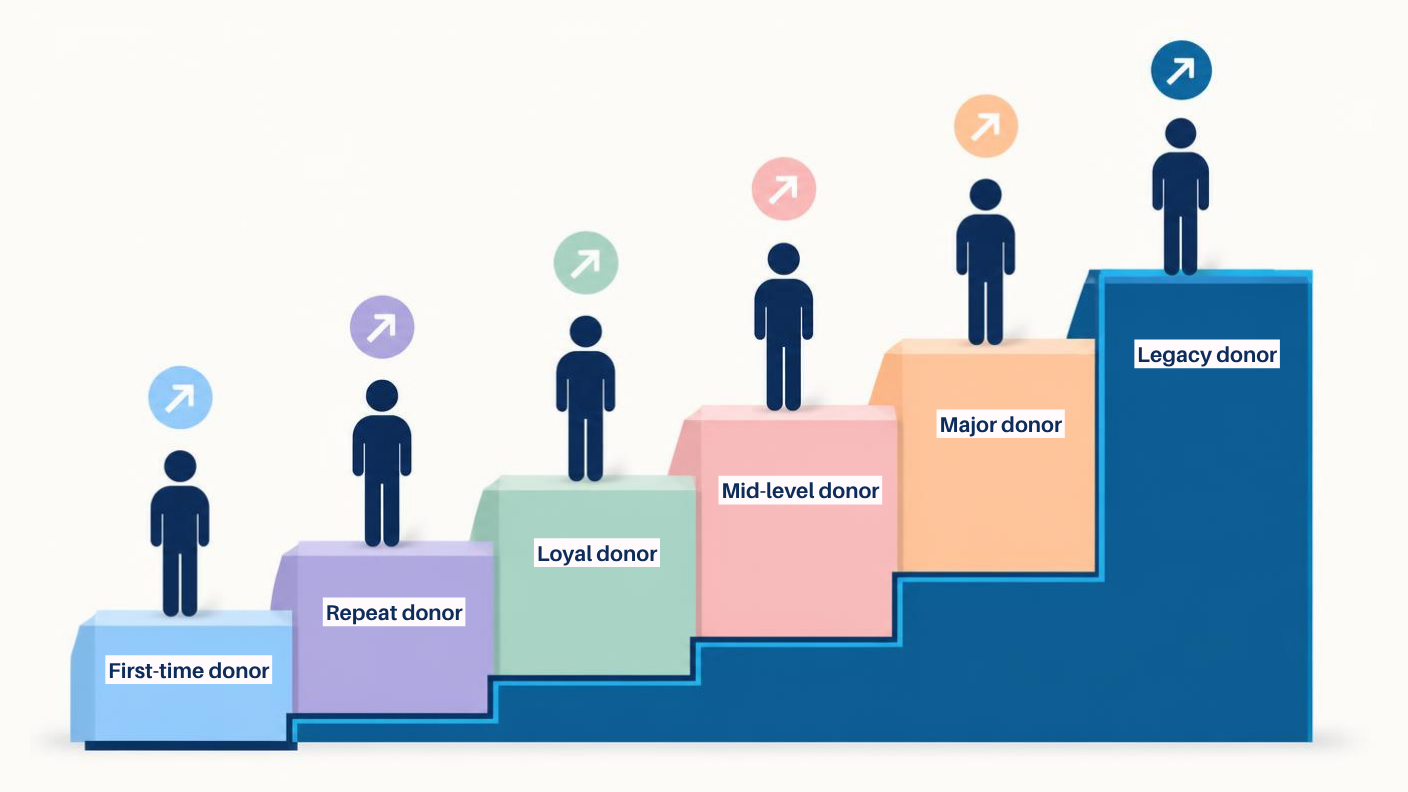
Almost every fundraiser has seen the donor lifecycle diagram. A tidy arc, or a pyramid, or a set of arrows: a donor arrives, gives again, becomes loyal, grows into a major donor, maybe leaves a legacy. It's a useful picture of how donors grow up.
The trouble is that, for many teams, it stays a picture. It lives on a slide, everyone nods, and then Monday morning the strategy that gets implemented is the one you have time for — which, worst case, means the whole file gets the same appeal.
The lifecycle is far more valuable than a diagram. It's an action map. Because the single most useful thing you can know about a donor isn't their gift total — it's what stage they're in, because the stage tells you the one move that matters most for them right now.
The good news is that with tools like RaiseTell, identifying and tracking donor stages is automated and painless. And proper use of AI tools for content creation can let a small team produce three to five times the iterations — individualizing content for more targeted groups of donors at different stages, and potentially even personalized messages for individual donors based on where they are.
The stages, and the move each one is waiting for
Here's the journey, with the next step each stage is actually asking for:
First-time donor. Someone just gave for the first time. The total is small; the moment is enormous. The first job is a fast, genuine thank-you and an early, easy reason to give again — because nothing else you do for this donor matters if they never come back. But the second gift is only the on-ramp to the milestone that really counts.
Repeat donor. They've given a second time — good, but you're not done. The move now is to get them to a third gift, because the third is where a donor stops being a maybe and becomes a habit, and where projected lifetime value climbs sharply. A monthly or sustaining track is often the surest way to get there.
Regular / loyal donor. They give dependably, year after year. This is the donor most likely to be taken for granted. The move here is to watch for capacity and upgrade signals, and to deepen the relationship before you ask for more.
Mid-level donor. They're giving meaningfully but below their capacity. This is your richest pipeline. The move is to filter for the most engaged and ready, then cultivate them with a human relationship and a personal, larger ask — carrying the best of them toward a major gift.
Major donor. A small number of relationships carrying a large share of the revenue. The move is intensive stewardship, genuine involvement, and — when the relationship is ready — opening the conversation about legacy.
Legacy donor. They've committed to give beyond their lifetime. The move is to honor and involve them, because they are now among your most important relationships, full stop.
The gift almost no one talks about: the third
Everyone talks about the second gift, and the second gift is real — most first-time donors never give one, and that cliff is where a lot of revenue quietly disappears. But the milestone that matters most is the one rarely discussed: the third gift.
Something changes at the third gift. A donor who gives three times behaves far more like a committed, long-term supporter than a two-time donor does — retention climbs steeply, and projected lifetime value jumps with it. The first two gifts can still be impulse or obligation; the third looks a lot like a decision to stick around.
That's why the highest-leverage early goal isn't simply "get the second gift." It's getting new donors all the way to their third — the point where a casual giver turns into a lasting one and the lifetime value you can project from them increases significantly. Every later stage of the lifecycle is fed by donors who cleared that bar, which makes the unglamorous work of moving new donors from gift one to gift three some of the most valuable work you can do.
Why "treat every donor the same" quietly fails
When the lifecycle stays a diagram, the default is one appeal stream for everyone. The brand-new donor, the fifteen-year loyalist, and the mid-level prospect all get the same email on the same day.
For each of them, it's the wrong move. The new donor needed a welcome and a gentle second ask, not a hard year-end push. The loyalist needed acknowledgment and a careful upgrade conversation, not a generic renewal. The mid-level prospect needed a phone call, not a mass email. Treating everyone the same isn't neutral — it actively pushes donors toward the wrong next step, or no step at all.
Matching the ask to the stage is what actually moves people forward. It's also simply more respectful of where each person is in their relationship with you.
Why the stage stays invisible
Here's the catch, and it's familiar by now: your CRM doesn't store a donor's lifecycle stage, and it certainly doesn't store their next best move. It stores gifts. "This donor is a first-time donor at risk of never giving again," "this loyal donor is showing upgrade capacity," "this major donor is ready for a legacy conversation" — none of those are fields. Each is a calculation across the donor's history, applied consistently across thousands of donors and refreshed as new gifts arrive.
So the stages exist, but they're locked inside the raw data, and assigning them by hand for a whole file is a project no team has time for. A report tells you what a donor has done. An analytic tells you what stage that puts them in — and what to do next.
From diagram to daily action
This is the kind of thing RaiseTell is built to do. It reads the gift history you already have, places each donor in their lifecycle stage, and surfaces the next move that matters most for them — the second-gift nudge, the upgrade signal, the major-gift cultivation, the legacy conversation — so the lifecycle stops being a slide and becomes a prioritized list of who to act on and how.
The lifecycle isn't there to be admired. It's there to tell you, for every donor in your file, what to do next. That's the difference between knowing the journey and actually moving people along it.
Want to see where your donors are in their journey?
RaiseTell places every donor in their lifecycle stage and surfaces the next move that matters most — automatically, from the gift data you already have.
Schedule a demo