Expansion: Retention's Missing Twin
By RaiseTell Team ·
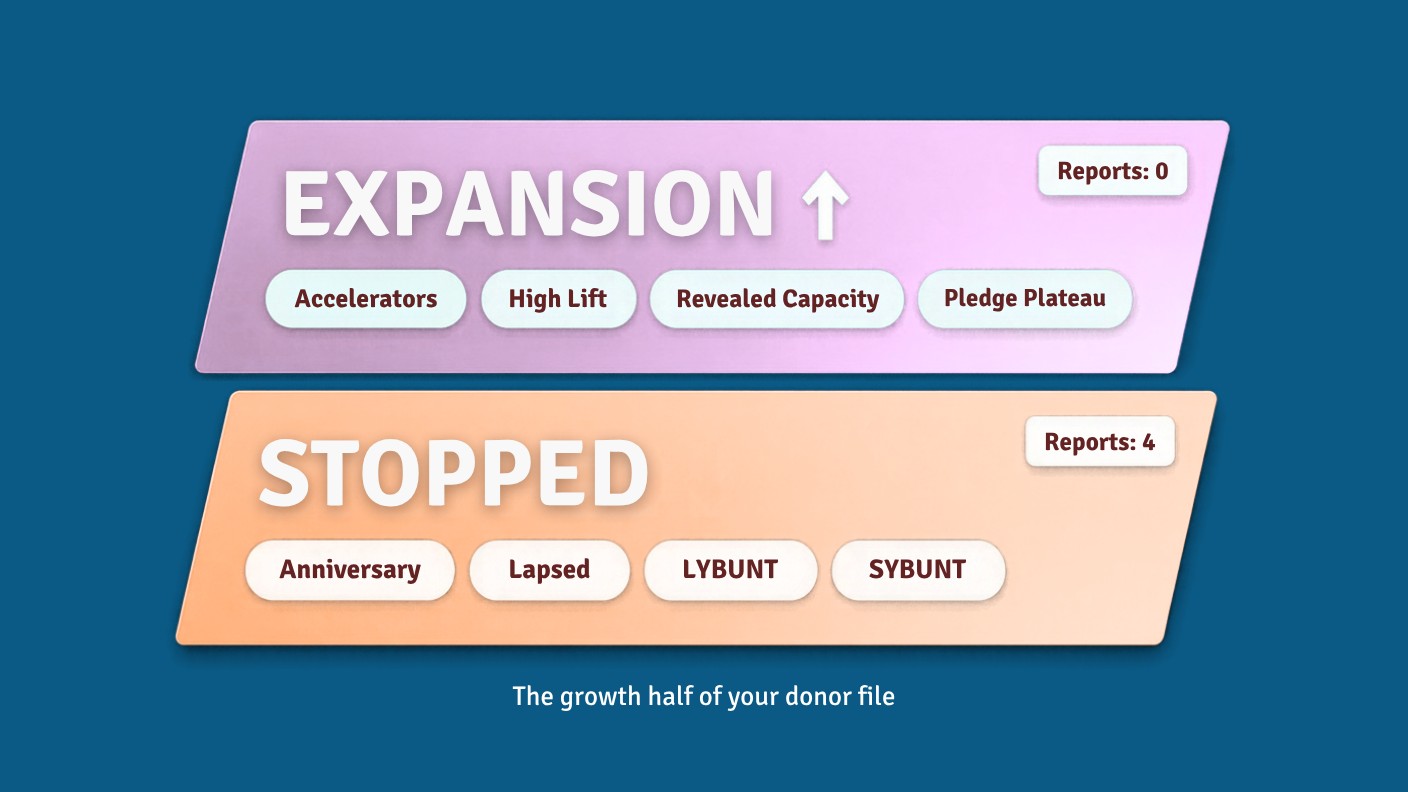
Look at the reports your team actually runs: anniversary, lapsed, LYBUNT, SYBUNT. They feel like four different tools, but they're really one report at four different intervals — each one drawing the line at a different point to answer the same question: who stopped giving? Your entire standard reporting stack — the thing your team might even call "analytics" — is a system for spotting donors who have walked out the door.
Now try to find the opposite report — the one that tells you who's ready to give more. In most organizations, it doesn't exist. And that omission has a cost, because the way donors move works in both directions, and you've instrumented only one of them.
Let's give the missing half a name: expansion.
Retention has a twin
Retention is, rightly, one of the most important KPIs in fundraising. Keeping a donor is cheaper and more valuable than replacing one, and a rising retention rate is genuinely good news. But somewhere along the way, retention became the dominant KPI — the headline number the whole sector points to — and its twin got left out of the conversation.
Retention asks a yes/no question: did they give again? Expansion asks a different one: did they give more? A donor who gave more this year than last has expanded — and that's a signal every bit as important as whether they renewed.
It's a term worth borrowing from the software and telecom industries, which have a lot in common with nonprofits: you build long-term relationships and try to grow them over time. The best SaaS companies don't just measure whether customers stay; they measure whether customers grow. Fundraising should too.
Why your reports can't see it
The reason expansion goes unmeasured is structural. Those four reports all fire on one thing: absence. A gift that didn't arrive, a renewal date that passed. That's the entire job they do — which means anything a still-active donor does is invisible to them.
A donor whose giving is climbing gift over gift never triggers a report, because they never stop. There's no absence to detect. Loss has an obvious trigger and practically reports itself; growth trips no alarm at all. So four reports watch the way out, and nothing watches the way up.
The four signals of expansion
When you read each donor against their own history instead of waiting for an absence, expansion resolves into four recognizable signals — none of which appears on a standard report:
Accelerators. Donors whose annual giving is rising year over year. Good scoring doesn't just flag that they're rising — it flags how much, whether they're up 0–25%, 25–50%, or more than 50%. A donor climbing steadily is telling you, in the clearest language a donor has, that the relationship is deepening.
High Lift. A recent gift far above a donor's own norm in a specific period. Think of a donor who reliably gives in March or April at tax time, and one year gives three, four, five times their three-year average for that month. That spike above their seasonal norm is a signal — and a forward-looking one.
Revealed Capacity. A gift the size you'd typically see from the segment above this donor. When someone's check size starts to look like the tier up, that reveals capacity — and an opportunity to move them up a level.
Pledge Plateau. Donors who recently made a major gift and are now making pledge payments to fulfill it. Their giving can look flat, like they're not on the way up — but many major donors give more than once. Until a major-gift officer removes them from the file as no longer a prospect, they remain a live prospect for expansion.
The upside is real — and mostly unseen
Expansion isn't abstract. When one organization looked for high-lift donors specifically, it found 67 who gave 3× or more their own three-year average, together representing $2.74 million in giving — expansion that no report ever flagged.
To be fair, not every one of those 67 gets missed. If a donor drops a transformational gift, their name is on the tip of every tongue on your team; you don't need a report for that one. But be honest: it is highly unlikely that anyone could name all 67 donors who significantly increased their giving in a period. Which means many of those signals were missed — and with them, the chance to reach out and strengthen the relationship while the moment was warm. Without a standard worklist for expansion, it's even possible that one of your largest donors on that list didn't get the stewardship their gift deserved.
Read the right way, that list isn't a record of the past. It's a forward indicator — the donors expanding now are the leading edge of your next major and legacy gifts.
Net revenue retention: expansion is the antidote to lapse
Here's the metric that ties both halves together, borrowed again from software and telecom: net revenue retention. Take a cohort's starting revenue, subtract what you lost to lapse, add what you gained from expansion:
Starting revenue − lapsed revenue + expansion revenue = net revenue retention.
Notice what's not in the formula: new-donor revenue. New donors are additive growth on top; net revenue retention measures how well you held and grew the donors you already had. In a healthy program, that number climbs above 100% — meaning expansion more than made up for lapse, every dollar of acquisition becomes pure growth, and you're clearly doing a great job stewarding existing donors.
That's genuinely hard to achieve when new-donor retention is under 20%, which is common. So here's the practical move: start by measuring net revenue retention on your 3+ gift donors — a cohort that has already shown real commitment and whose lifetime value is significant. If that looks strong, drop back a level and measure it across your 2+ gift donors. Expansion is the lever that makes that number climb. It is, quite literally, the antidote to lapse.
Today's expansion is tomorrow's major gift
Most major and legacy donors were once a smaller donor who expanded — it's rare to start at the top. That's why expansion matters so much more than any single year's revenue: the expansion signals are the early markers of your future major and legacy donors. Catch an accelerator, a high-lift gift, or revealed capacity early, and you're not chasing this year's number — you're building the major- and legacy-gift pipeline years before those donors land on anyone else's radar. Act now while the fire is lit — a call, a thank-you, a real conversation — and you fan that spark into a lifelong commitment.
Measuring the half you've been missing
This is exactly what RaiseTell is built to surface. Alongside the donors at risk, it reads each donor's giving against their own history and flags the expansion signals your standard reports can't — the accelerators, the high-lift gifts, the revealed capacity, the pledge plateaus — so the growth hiding in your file becomes a working list, and your future major and legacy donors become visible while there's still time to cultivate them.
You've spent years automating the search for bad news. The good news has been sitting in the same database the whole time. Measure expansion, not just retention — and start finding the donors who are already telling you they want to give more.
Want to see who's expanding in your file?
RaiseTell reads the giving history you already have and surfaces the accelerators, high-lift gifts, and revealed capacity your standard reports can't — while the moment is still warm.
Download the guide