Why Lifetime Value Matters More Than Gift Size
By RaiseTell Team ·
Open almost any donor list and look at how it's sorted: by last gift, or by largest gift. The biggest number floats to the top, and that's where the attention goes.
But gift size is a snapshot — one frame of a much longer movie. What you actually care about is what a donor is worth going forward: the value of the whole relationship still ahead of you. The trouble is, that number is genuinely hard to pin down. And the honest way to handle that difficulty is the whole point of this piece.
The honest problem: you can't predict one donor
Here's the uncomfortable truth about "lifetime value." For any individual donor, you can't actually calculate it. At any moment, a donor may simply stop — move, lose interest, have a hard year — and there's no model that reliably tells you when. Even future value for a single named person is, strictly speaking, unknowable. Anyone who promises you a precise dollar figure for one donor's future is selling certainty that doesn't exist.
So does that make the whole idea useless? No — it just means you apply it the right way.
What you can't do for one donor, you can do for a group
Here's the move that makes future value usable: donors who have behaved similarly in the past tend to behave similarly in the future.
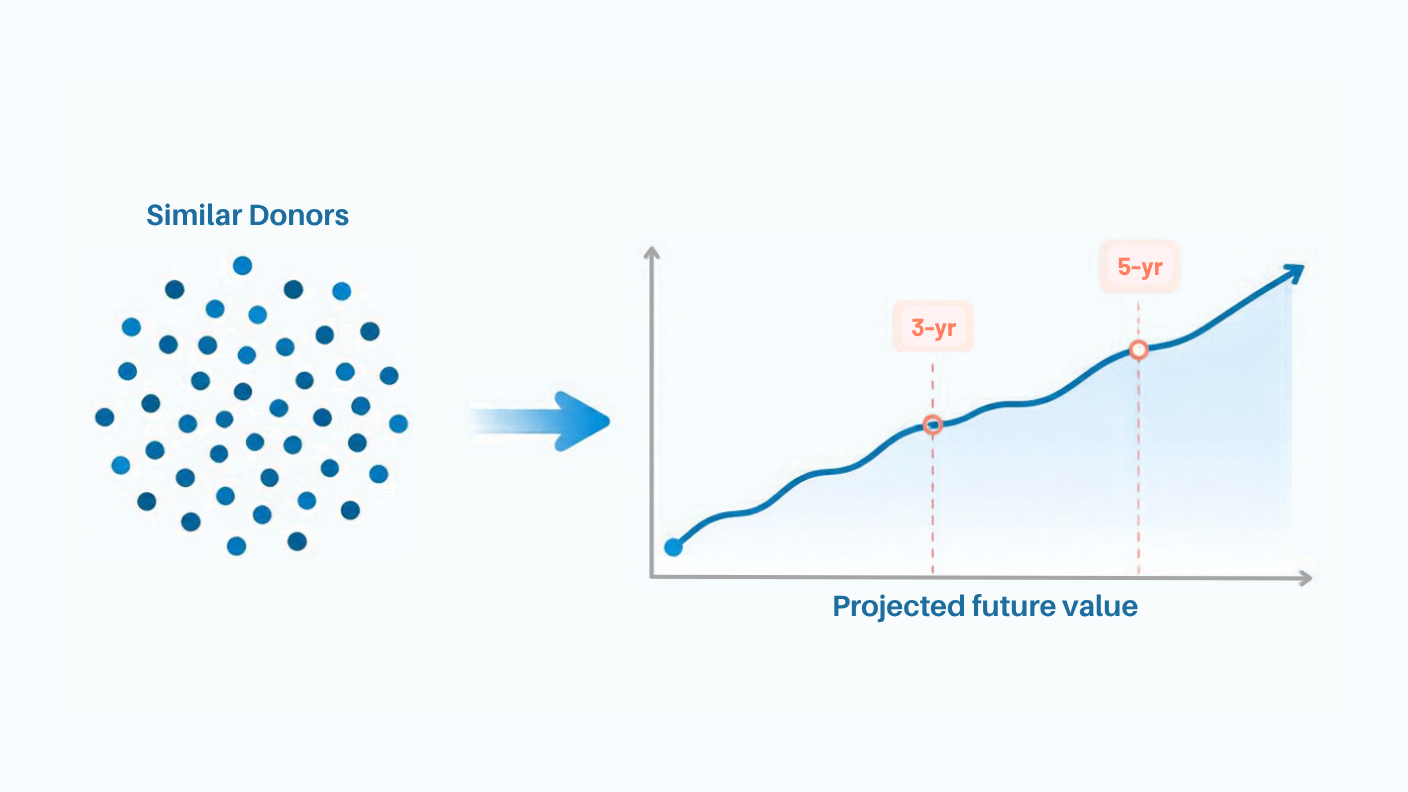
You can't predict the individual, but you can project the group. Take all the donors who look alike on the behaviors that matter — how recently and often they give, how long they've been giving, whether their giving is trending up — and look at what donors like that actually went on to do. That group's future is observable and stable. Then you assign that group's projected value back to each individual in it, as an estimate.
It's a projection, not a promise. Any single donor may beat it or fall short. But across a group it holds up well, and — crucially — it's exactly good enough for the one decision that actually matters: where your team spends its limited attention. Rank your file by projected future value and work from the top, and you're pointing your scarcest resource at the donors most likely to be worth it.
A practical rule of thumb: build those projections on three- and five-year windows of giving history. Three years is responsive enough to catch where a donor is heading; five years is stable enough to smooth out the noise of any single year. Looking at both gives you a fuller, more trustworthy picture than either alone.
A snapshot lies; a projection tells you where to look
Picture two donors.
The first writes a single $1,000 check at a gala and is never heard from again. On a gift-size list, they sit near the top.
The second sets up a $25 monthly gift — $300 a year — and quietly keeps giving. On a gift-size list, they're invisible near the bottom.
Now project forward from how donors like each of them behave. The committed monthly donor passes that one-time $1,000 somewhere in year four — and, true to the pattern of retained monthly donors, keeps going. The gala donor, matching the pattern of one-time event givers, mostly doesn't. The donor who looked small projects to be worth more than twice the one who looked big. Gift size pointed you at the gala donor; projected future value points you at the relationship actually worth protecting.
What drives a donor's projected future value
The projection isn't magic; it's built from a few behaviors that reliably define how a group will give going forward:
Retention — how likely donors like this are to give again. The single biggest factor, at any gift size.
Frequency — how often they give in a year. Monthly and repeat patterns compound far faster than annual ones.
Tenure — how long the relationship has lasted. Long-tenured small donors routinely out-project one-time "major" gifts.
Trajectory — whether giving is trending up or down. A rising donor projects to far more than their current gift suggests.
Notice what's missing: the size of any single gift. Gift size is an output of these behaviors in one year, not what determines the value still to come.
The floor, not the ceiling
One important caveat, to keep this honest. Everything above is about regular giving — a donor's repeating pattern, at whatever level is normal for them. Projected future value models that dependable stream well; call it the floor you can plan on.
It does not capture the occasional gift that's outsized relative to a donor's own norm. Those can't be projected with precision. Giving history shows the strength of a relationship and hints at capacity, and you can sharpen the picture with enrichment data — wealth ratings, real-estate or business holdings, other philanthropic giving. All of it tells you where to invest. But whether a donor actually makes that larger gift is relationship-dependent. So treat projected future value as the floor, and the exceptional gift as upside you earn, donor by donor, through relationship.
Why the snapshot wins by default
If projected future value is so much more useful, why does almost everyone still sort by gift size? Because gift size is sitting right there in the database, and a projection isn't.
Last gift and largest gift are stored fields — one query away. Projected future value has to be modeled: group donors by behavior, measure what comparable groups did over three- and five-year windows, assign the projection to each donor, and refresh it as new gifts arrive. That's not a column you can sort; it's a calculation across the whole file. So teams default to the number they can already see, even though it points them at the wrong donors.
A report tells you what a donor gave. An analytic tells you what they're projected to be worth — and therefore who deserves your time.
Ranking by what actually matters
This is the kind of thing RaiseTell calculates for you. It reads the giving history you already have, groups donors by the behaviors that drive future giving, and projects each donor's future value over three- and five-year windows — so you can rank and segment your file by what a relationship is likely to be worth, not by whose last check was biggest. The loyal small donor stops being invisible, and the one-time big gift stops crowding out the people projected to be worth far more.
Gift size will always be easy to see. Projected future value is what's actually worth managing — and it's usually highest in the donors a gift-size list tells you to ignore.
Want to see your donors' projected future value?
RaiseTell groups donors by behavior and projects future value over three- and five-year windows — so you rank by relationship potential, not last gift.
Schedule a demo