The Third Gift Is the Finish Line
By RaiseTell Team ·

Ask most development teams which gift matters most and you'll hear "the first one" — the moment a stranger becomes a donor. It's a real milestone, and worth celebrating. But it's also the least predictive gift a donor will ever make. The gift that actually tells you whether you have a lifelong supporter isn't the first. It's the third.
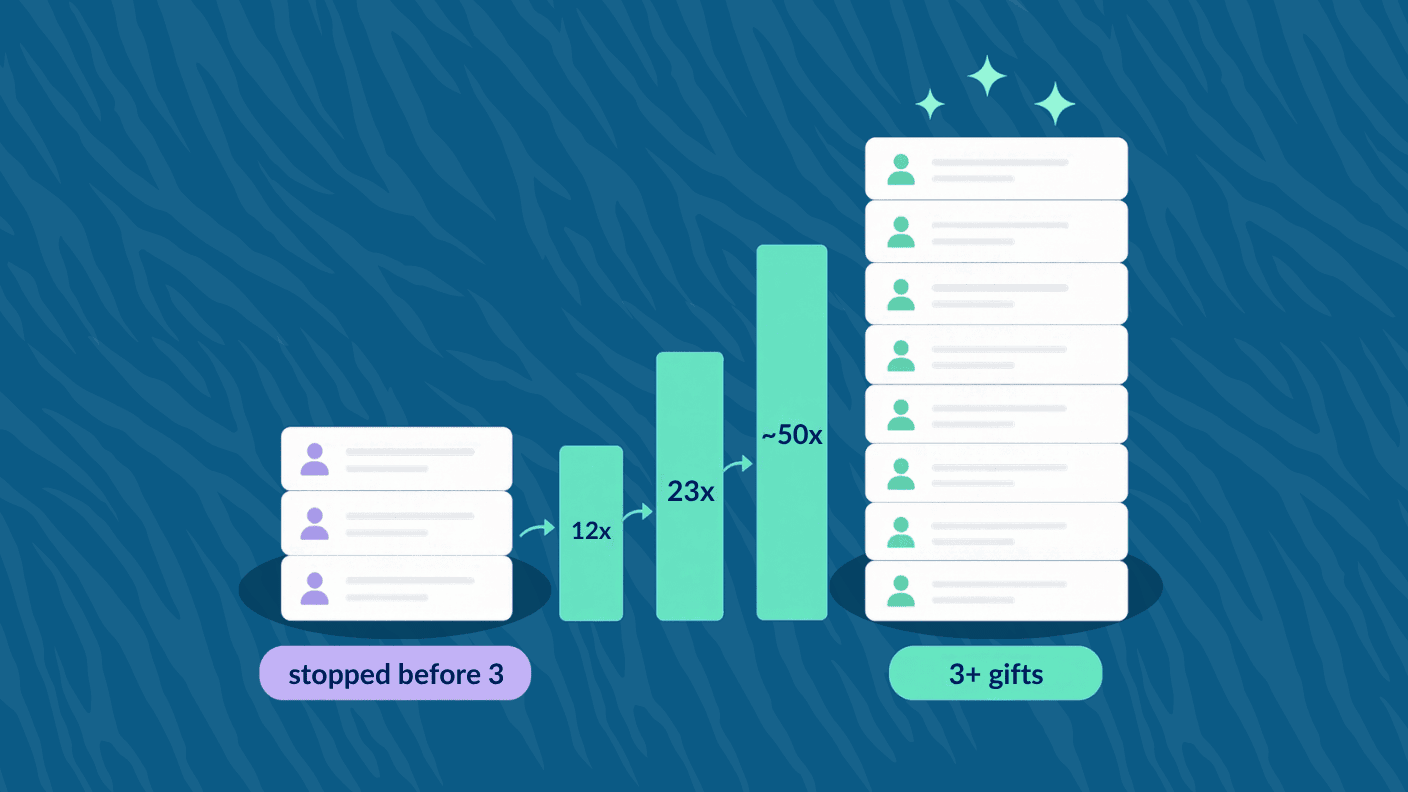
There's a threshold in every donor's history, and it sits right around the third gift. Get a donor there, and their odds of staying with you for years jump dramatically. Fail to, and most of them quietly disappear — often after giving only once. The whole early journey, from first gift to third, is the stretch that decides who becomes a lifetime donor and who becomes a line item in next year's lapsed report.
The retention cliff nobody puts on the dashboard
Here's the uncomfortable pattern hiding in almost every donor file. Of the first-time donors you worked so hard to acquire, only a minority ever give a second gift. The drop-off between the first gift and the second is the steepest cliff in fundraising — and it's the reason acquisition-heavy programs feel like running up a down escalator.
But the donors who do come back behave very differently. Second-gift donors renew at a much higher rate than first-time donors. And third-gift donors? They renew at a rate that looks almost like a different species entirely.
The shape, illustratively, looks like this: retain roughly a quarter of donors after the first gift, close to half after the second, and around 80% after the third. (Illustrative — your exact rates will differ, but the climb is real and it's steep.) Each gift a donor makes isn't just revenue; it's a signal that they're more likely to give again. And the third gift is where that signal crosses from "maybe" into "loyal."
Why the third gift, specifically
Why does the curve bend so hard at three? Because three gifts is the point where giving to you stops being a one-off decision and becomes part of how a donor sees themselves.
A first gift can be an impulse — a friend asked, a story landed, a year-end deadline loomed. A second gift says the first wasn't an accident. But a third gift is a pattern, and patterns are how people form identities. Somewhere around that third gift, a donor stops thinking "I gave to that organization once" and starts thinking "I'm a supporter of that organization." That identity shift is what retention is really made of — and it's why the projected lifetime value of a donor who reaches gift three towers over one who stops at one or two.
This is the same truth that runs under everything: donors who behaved similarly tend to keep behaving similarly. A donor who has given three times has shown you a pattern of coming back. The math simply follows the behavior.
The journey is designed, not hoped for
If the third gift is the finish line, the natural question is: how do you get more donors across it? And the answer is that the first-three-gifts journey should be designed, not left to chance.
Most programs treat a brand-new donor and a five-year loyalist exactly the same — same appeals, same cadence, same generic thank-you. But a donor's first 90 days, and their first three gifts, are the highest-leverage window you have. That's when affinity is freshest and the identity shift is still up for grabs. A deliberate early journey does a few things well:
It thanks fast and specifically. A prompt, real thank-you after the first gift — not a receipt — is the single most correlated action with a second gift.
It makes the second ask soon and easy. The longer the gap after a first gift, the colder the donor. A timely, low-friction second ask, tied to the thing they already cared about, is what turns one gift into two.
It builds toward the third. Once a donor gives twice, the goal shifts to establishing rhythm — a monthly option, a connected next appeal, a reason to give again while the relationship is warm.
None of this is exotic. It's onboarding — the same discipline any good organization applies to a new relationship. The only hard part is knowing where each donor is in the journey.
Why teams miss it
If the third gift is this important, why doesn't every program obsess over it? Because seeing the journey is the hard part. Knowing which donors are sitting at one gift, which just made their second and are ripe for a third, and which have stalled and are cooling off requires tracking gift counts and timing across the whole file — and refreshing it constantly as gifts arrive.
That's not what a standard report gives you. A report tells you how much came in this month and from whom. It won't tell you "these 140 donors gave a second gift in the last 60 days and haven't been asked for a third" — which is precisely the list that moves the retention needle. That's the difference between a report, which describes what happened, and an analytic, which tells you what to do next.
One honest note: the third-gift threshold is a powerful pattern, not a guarantee. A donor can reach three gifts and still lapse, and relationship and mission always matter more than any single number. What the pattern does is tell you where to aim — it points your limited time at the donors on the cusp of becoming loyal, instead of spreading it evenly across a file where most of the leverage sits in one narrow window.
Surfacing the journey
This is exactly what RaiseTell is built to make visible. It reads the giving history you already have, counts where each donor sits in the journey, and surfaces the ones on the edge of the next gift — the first-time donors who need a fast, warm second ask, and the second-gift donors who are one well-timed appeal from crossing into loyalty. Instead of guessing, you get a working list of who's closest to the third-gift finish line and what will get them there.
Acquisition gets the applause, but the third gift wins the marathon. Move more donors from one gift to three, and you're not just raising more this year — you're building the loyal base that funds every year after.
Want to see who's on the cusp of their third gift? [Download the guide →](/demo)
Want to see who's on the cusp of their third gift?
RaiseTell reads the giving history you already have and surfaces the donors closest to the third-gift finish line — and what will get them there.
See your third-gift candidates