When Donors Give: Why Every Donor Has Their Own Season
By RaiseTell Team ·
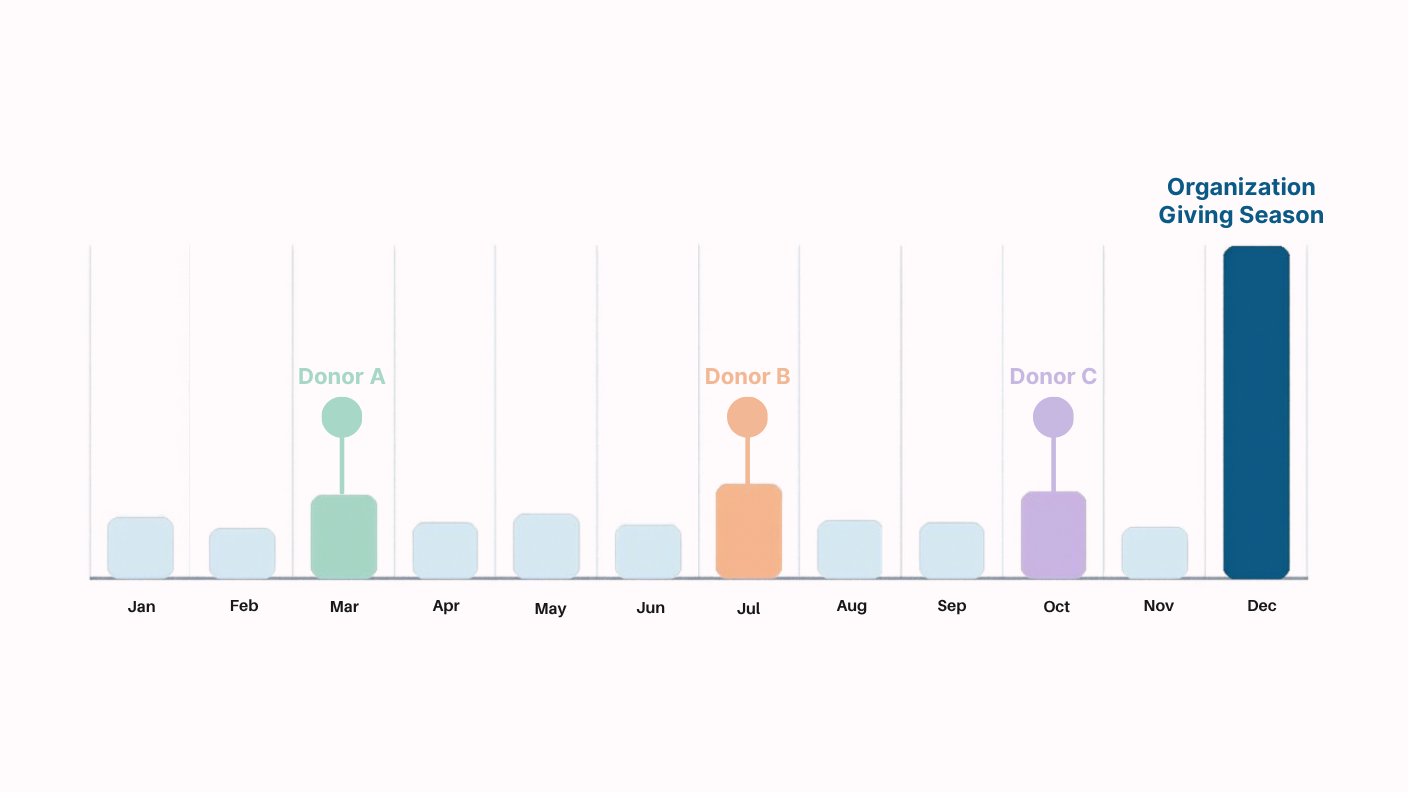
Ask any fundraiser when their donors give and you'll get the same answer: December. And they're not wrong. Year-end is real, the holidays are real, the tax deadline is real, and for most organizations the calendar's biggest spike sits right there at the end of the year.
But "December" is the org-level answer. It's the sum of thousands of individual decisions, and it hides something far more useful: every donor has their own season.
Some of your donors give every July, like clockwork, around the anniversary of their first gift. Some give in the spring when their own finances reset. Some give in October because that's when your event has always been. The year-end spike is just where all those personal rhythms happen to overlap — but underneath it, your file is full of donors whose primary giving month(s) are nowhere near December.
And most organizations ask all of them at the same time anyway.
The cost of asking everyone at once
When you treat seasonality as a single org-wide event, you do what almost everyone does: you save your energy for the year-end push and blast the entire file in November and December.
For the donors whose season actually is December, great — you met them where they are. But for the donor who reliably gives in March, a December ask lands at the wrong moment. They may give anyway, out of loyalty, but you've asked them at their least likely time — and you've spent a year of attention pointed at the wrong month. Worse, you've trained yourself to ignore them for the other eleven.
Timing is one of the only levers in fundraising that costs nothing to pull. You can't easily change who your donors are or how much they can give. You can absolutely change when you ask. And asking a donor in their month, rather than yours, is the closest thing to free money in the building.
What "a donor's season" actually looks like in the data
This isn't a vibe; it's a pattern you can calculate. For most donors with any history, a clear rhythm emerges:
Mode gift month. The month a donor gives in most often. For a surprising share of your file, gifts cluster in one or two months year after year — and for many of them, it isn't December.
Anniversary giving. Donors who give around the date they first gave, or around a recurring life or calendar event. The gift is tied to a moment, not a campaign.
Seasonal cadence. Donors who give twice a year on a predictable split — say, spring and fall — or who reliably renew a set number of months after their last gift.
None of these are exotic. They're sitting in every gift record you have. The problem is that no one has the time to read them donor by donor, so the rhythm stays invisible and everyone defaults to December.
Your largest donors give on a financial calendar
This matters most at the top of your file. For major and principal donors, the "season" often has nothing to do with sentiment and everything to do with their own cash flow and financial planning. The gift moves when the money does.
Think about what actually drives a large gift's timing: appreciated stock gifted before year-end to capture the deduction; a required minimum distribution or qualified charitable distribution from a retirement account; a bonus, a vesting date, or a liquidity event like the sale of a business; a donor-advised fund the donor tops up at a set time of year; or a family foundation working to its own fiscal year and payout schedule. Each of those is a recurring financial moment, and the gift tends to ride along with it.
The practical upside is significant. If you know a major donor consistently gives appreciated stock in early December, you don't open that conversation in December — you have it in October, while there's still time to plan the transfer. If a donor's gifts track their IRA distribution each fall, you align the ask to that window. Meeting a major donor on their financial calendar isn't just good timing; it signals you understand how thoughtful giving actually works at that level, which is exactly the sophistication those relationships expect.
Seasonality also protects you
There's a defensive reason to understand this, too. An organization that knows its giving is dangerously concentrated in December is an organization that knows it's one bad year-end — one storm, one news cycle, one distracted month — away from a serious miss.
When you understand the individual rhythms underneath the spike, you can start to smooth the curve: cultivating spring and summer donors in their seasons, moving some renewals off the December cliff, and building a year that doesn't live or die in the last three weeks. You're not fighting seasonality; you're using all of it instead of just the loudest part.
Why this stays hidden
It's the same reason every useful pattern stays hidden: your CRM stores gift dates, not gift rhythms. "This donor's mode month is July" is not a field you can pull. Neither is "this donor renews about ten months after their last gift" or "this donor's giving has drifted from spring to fall over three years." Each one is a calculation across a donor's full history — and then across thousands of donors, refreshed as new gifts come in.
So the rhythm exists, but it's locked inside the raw dates, and reading it by hand for a whole file is a project no team has time for. A report tells you what happened — Jane gave on July 12. An analytic tells you what to do — Jane gives nearly every July; reach out in late June, not in your December blast.
Meeting each donor in their season
This is the kind of thing RaiseTell calculates for you. It reads the gift history you already have and surfaces each donor's rhythm — their mode gift months, their anniversaries, their seasonal cadence — alongside your organization's overall curve. Instead of one giant December list, you get the right donors surfaced in the right months, all year long, so your outreach lands when each person is most ready to give.
Year-end will always matter. But the donors who don't give in December are still giving — just somewhere else on the calendar. Knowing where is how you stop leaving the other eleven months on the table.
Want to see when your donors actually give?
RaiseTell surfaces each donor's giving rhythm — mode months, anniversaries, and cadence — so your asks land in their season, not just yours.
Book a Demo